Planetary Nebulae
Planetary Nebulae
  Flash infos:!!! Le site PNnet fait peau neuve !!! - Dernières observations: Ra 25 le 15/03/2026    BMP J1608-5913 le 25/02/2026    K_2-17 le 23/02/2026    
Balance sheet of amateur PN spectroscopic observations
  30 Septembre 2020 - Lionel Mulato  Actualité du site   
Introduction

In the late 2000s amateur astronomers began to discover a great number of new Planetary Nebula (PN) candidates. The first PN candidates were discovered by chance by astrophotographers while taking deep narrow band images of the sky. But the number of discoveries has significantly increased as amateurs started to search PN trough professional wide field surveys such as SHS, IPHAS, WISE and now VPHAS+.

The status of newly discovered objects remains uncertain until a spectrum is performed. Even if narrow band images leave little doubt about the fact that an object is a PN, an optical spectrum is necessarily needed to confirm its nature. And it can take years to get a confirmatory spectrum from a professional observatory.

This situation was a bit frustrating for amateur discoverers. In France there is a fairly small but very active amateur community of spectroscopists. Owing the rising number of new candidates discovered by amateurs, an amateur spectroscopic observation program started in 2015.


Number of observed PN candidates

On 18 September 2020, the number of PN candidates spectra performed by amateurs is about 230. Figure 1 shows the number of observations per year from 2011 to September 2020.

First spectra were acquired back in 2011. The observations became more intensive from 2015 and increased significantly in 2019. More than 70 spectra are now performed per year, exclusively in the northern hemisphere. The southern hemisphere will soon be covered by 2SPOT.


Status of PN: Possible, Likely, True PN or mimic ?

All our data is ingested into HASH PN database produced by Prof. Quentin Parker and now maintained by Dr. Andreas Ritter at The University of Hong Kong : Parker, Bojicic & Frew 2016. The status of observed PN candidates is updated in HASH accordingly by Prof. Quentin Parker.

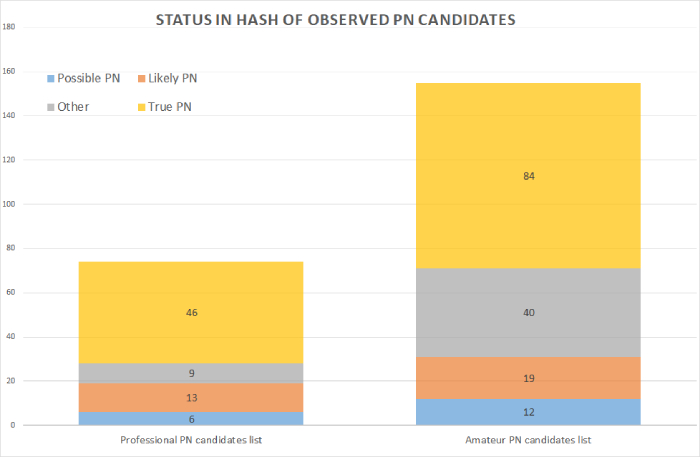
Figure 2 shows the different statuses of the observed objects (status on September 2020) and the origin of their discovery (amateur or professional discovery).

There are 3 major statuses for PNe :
- True PN which means that the object is confirmed as a PN. The optical spectrum must show clear evidence of PN characteristics. But this is not the only condition to be met. The confirmation requires the compliance of multiple criteria based on the analysis of multi-wavelength surveys (X, UV, optical, NIR, MIR, radio...),
- Likely PN which means at this point that the object is still a PN candidate, but with a good probability of being a True PN. The object needs more investigations (deeper spectrum, better S/N ratio spectrum...),
- Possible PN which means that the object might be a PN but further investigation is needed.

Sometimes PN candidates turn out to be objects completely unrelated to PNe. These objects are PN mimics categorized as "other" in the figure 2 (below) and are mainly HII regions, emission line galaxies, supernova remnants, emission line stars... or simply objects of unknown nature based on available data.

The amateur spectroscopic observations are not only focused on amateur discoveries but also on professional discoveries which lack an optical spectrum. The origin of the discoveries is somewhat controversial. Several recent discoveries attributed to amateurs have been in fact already noticed years ago by professionals. But their discoveries are yet unpublished.

Figure 2 shows that amateurs have helped to confirm nearly 130 True PN both from amateur or professional PN candidates lists. This is an appreciable amount (5%) of the total number of known True PNe (~2600 True PN in HASH Database). Amateurs observations can also provide a good first estimation for deeper further investigations.

Fig2: status in HASH Database (September 2020) of observed PN candidates from amateur or professional lists
Where and who ?

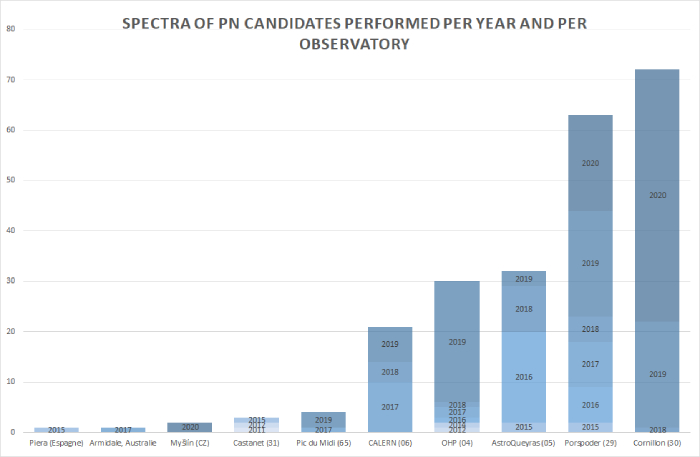
Figures 3 shows the annual number of performed spectra per observatory.

The main data providers are observatories based at Cornillon (L. Mulato) and Porspoder (P. Le Dû), both using a rather small telescope aperture (20 cm) with a low resolution spectroscope.

A lot of spectra have also been performed during the spectro-parties at l'Observatoire de Haute Provence by C. Buil, S.Charbonnel, O. Garde, P. Le Dû, T. Lemoult, L.Mulato and T. Petit.

Every year we are allowed to use professional telescopes with a larger aperture (up to 1m) at Calern, Astroqueyras or Pic du Midi observatories. The observational team is made up of a large number of amateur astronomers : G. Arlic, P. Bazar, A. Brémond, C. Buil, S.Charbonnel, P. Dubreuil, O. Garde, B. Guégan, V. Lecoq, P. Le Dû, T. Lemoult, M. Leveque, A. Lopez, J-P. Nougayrede, J. Souchu.
Fig3: number of spectra of PN candidates performed by amateurs per year and per observatory
Planetary Nebulae
  Rubriques
AccueilTables
I, II, II, IR
Documentation
Collecte
de données
PublicationsConfirmations
spectroscopiques
  Statistiques
  1284 entrées au total, dont:
    - 166 nébuleuses planétaires
    - 97 nébuleuses planétaires probables
    - 67 nébuleuses planétaires possibles
    - 664 nouvelles candidates
    - 290 autres objets
  Accès rapides
 HASH:the Hong Kong/AAO/Strasbourg Hα planetary nebula database
 2SPOT:the Southern Spectroscopic Project Observatory Team
 CDS:Strasbourg astronomical Data Center
  Confirmations spectroscopiques
 478 observations réalisées
 Lien vers la liste des observations spectroscopiques: ICI
    Ici, toutes les observations spectroscopiques réalisées
 par le French Amateur Group sur les candidates
 nébuleuses planétaires.
  Candidates NP non publiées
 548 candidates NP non publiées.
 Accéder à la liste complète: ICI
    Les candidates sont dites "publiées" lorsqu'elles font
 l'objet d'une publication officielle dans VizieR et dans le
 CDS de l'université de Strasbourg.
Planetary Nebulae
Planetary Nebulae .net
Contacts: - responsable NP et candidatures: Pascal Le Dû (pascal.ledu@2spot.org)
- responsable site internet: Thomas Petit (thomas.petit@2spot.org)
© Planetary Nebulae .net - Tous droits réservés
Le site Planetary Nebulae .net offre toutes les informations utiles et pratiques concernant les (candidates) nébuleuses planétaires francophones, la manière de poser une candidature pour une nouvelle découverte ainsi que la marche à suivre pour la confirmation des candidates. Si vous souhaitez contribuer au site, merci de consulter la page Collecte de données et de nous contacter.
Contributeurs: Pascal Le Dû - Thomas Petit - Olivier Garde - Nicolas Petit - Trygve Prestgard - Jean-Baptiste Feldmann - Lionel Mulato - Sakib Rasool - Dana Patchick - Xavier Strottner - Jean-Baptiste Auroux